DISCOVER THE WORLD OF MUSICAL THEATRE WITH ME
DISCOVER THE WORLD OF MUSICAL THEATRE WITH ME


Simple little things
All I want are simple little things
All I need is someone beside me to have and to hold
Someone to love me as we grow older
Lizzie Curry
110 in the Shade
In a drought-stricken Western town, a sharp-tongued, unmarried woman dares to believe in love and change when a charming con man known as the Rainmaker arrives, forcing the community and herself to confront the difference between illusion, faith, and genuine self-worth.
"110 in the Shade" is a musical that premiered on Broadway in 1963 with a book by N. Richard Nash, music by Harvey Schmidt, and lyrics by Tom Jones. The musical is based on Nash's play "The Rainmaker", which he also adapted into a screenplay for a 1956 film. It wasn't until several decades later that the show was revived for the first time in 2007.
The musical revolves around Lizzie Curry, a spinster living in a drought-stricken town in the American Southwest during the 1930s. Facing the oppressive heat and lack of rain, the community's spirits are dampened. Lizzie's life takes an unexpected turn when a charismatic con man named Bill Starbuck arrives promising to bring rain and change their fortunes. As Starbuck's presence stirs up hope and desire in the townspeople, Lizzie finds herself torn between the charming stranger and a local sheriff File who has feelings for her.
The musical explores themes of love, self-discovery, and the transformative power of hope in the midst of challenging circumstances. With a rich score and compelling characters, "110 in the Shade" is a poignant and uplighting tale set against the backdrop of a parched landscape seeking relief from both the literal and metaphorical drought.
N. Richard Nash
Harvey Schmidt
Tom Jones
G
2
Original Broadway Musical - 1963
Broadway Revival - 2007
Drama, Romance, Comedy
1963, small town in southwestern U.S.
Cast Size: 1 F, 5 M
Large Ensemble - Townspeople
Some dancing
Male Cast, Adults, Young Adults, Late Teens, Children,
Professional Theatre, College Theatre, Community Theatre, High School Theatre

In the early 1950s, playwright N. Richard Nash wrote a play titled, "The Rainmaker". The play was then picked up by director Joseph Anthony and producer Ethel Linder Reiner, and after rehearsals, the show was opened to the public at Cort Theatre in New York City on October 28, 1954. It ran for 125 performances and was received well by critics and audiences alike.
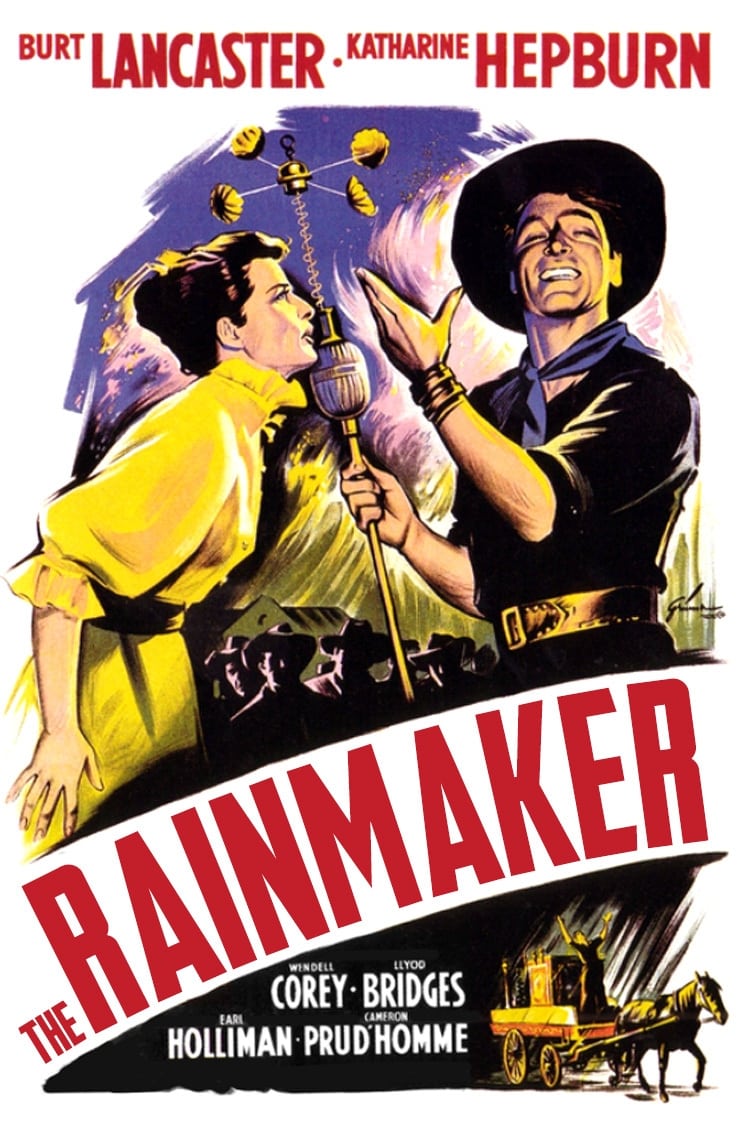
Later on, the story was then adapted into a film written by the same N. Richard Nash and directed again by Joseph Anthony. The film went into theatres on December 13, 1956 starring Burt Lancaster and Katharine Hepburn.
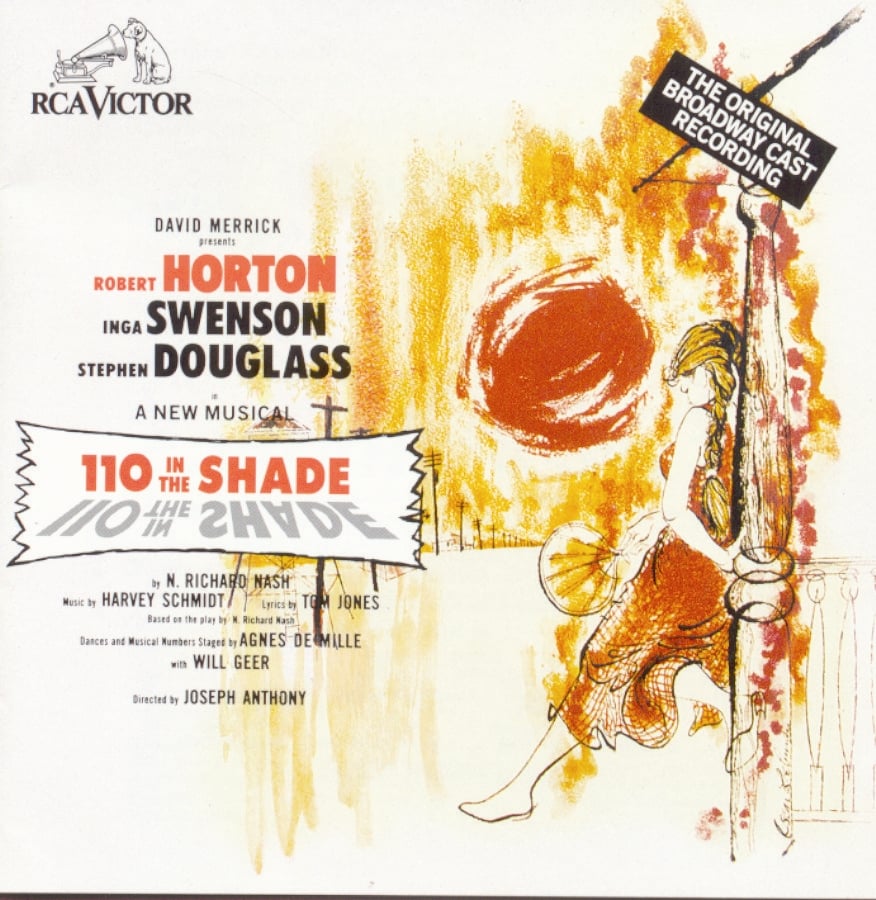
A few more years later, the story was brought back up again to be adapted into a musical with the help of Harvey Schmidt and Tom Jones. This was the duo's Broadway debut after their wildly successful work of the off-Broadway musical "The Fantasticks". Joseph Anthony came back to direct the story along with choreographer Agnes de Mille, producer David Merrick, and set designer Oliver Smith. After two previews, the production opened on October 24, 1963 at the Broadhurst Theatre with a cast that included Robert Horton, Inga Swenson, and Stephen Douglass. The show was met with positive reviews from critics, but audiences were not as thrilled by the story thus running for a total of 330 performances.
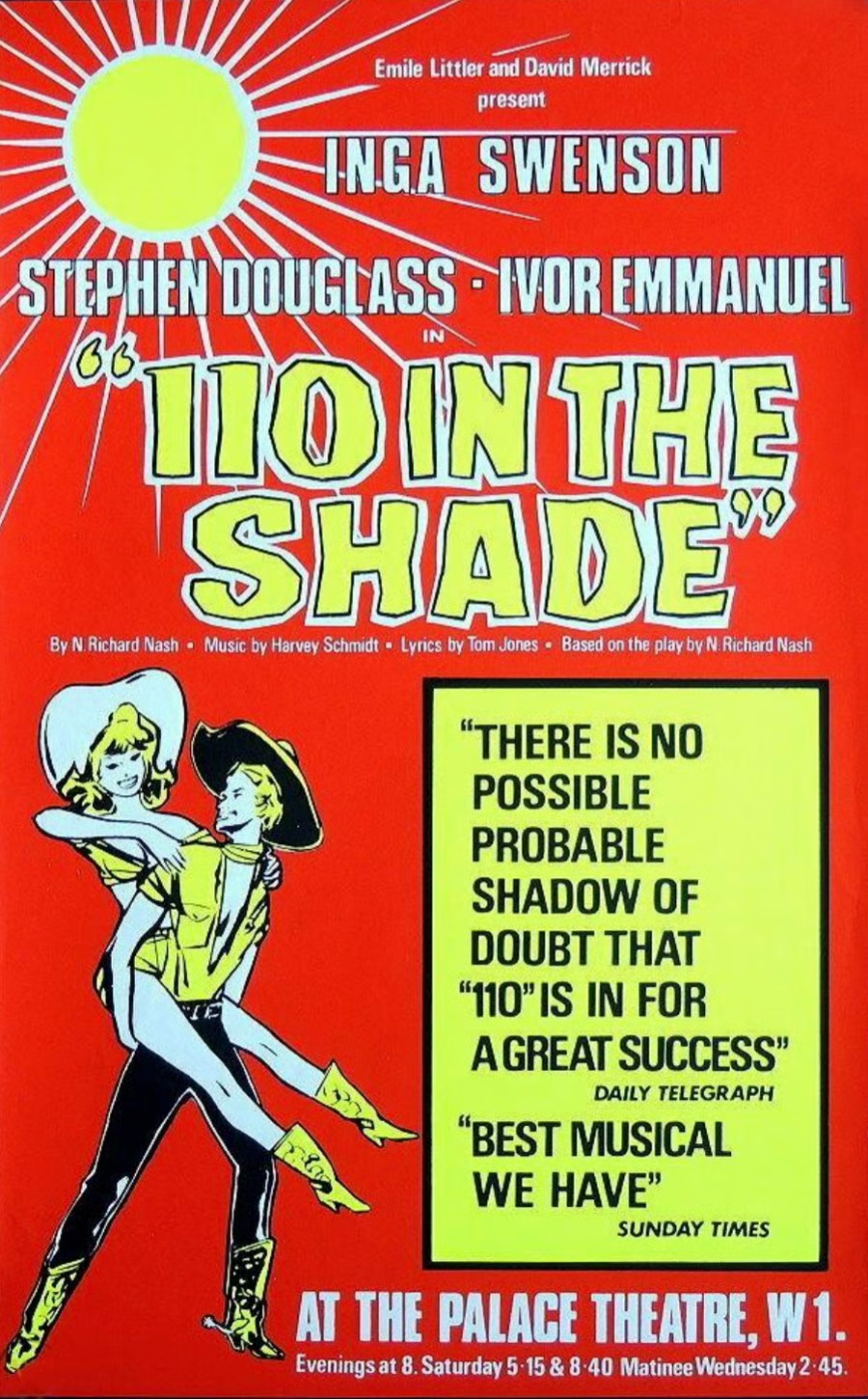
Opened on February 8, 1967, "110 in the Shade" had its first and only West End production at the Palace Theatre.
Not much is known about it, only that it ran for 101 performances.
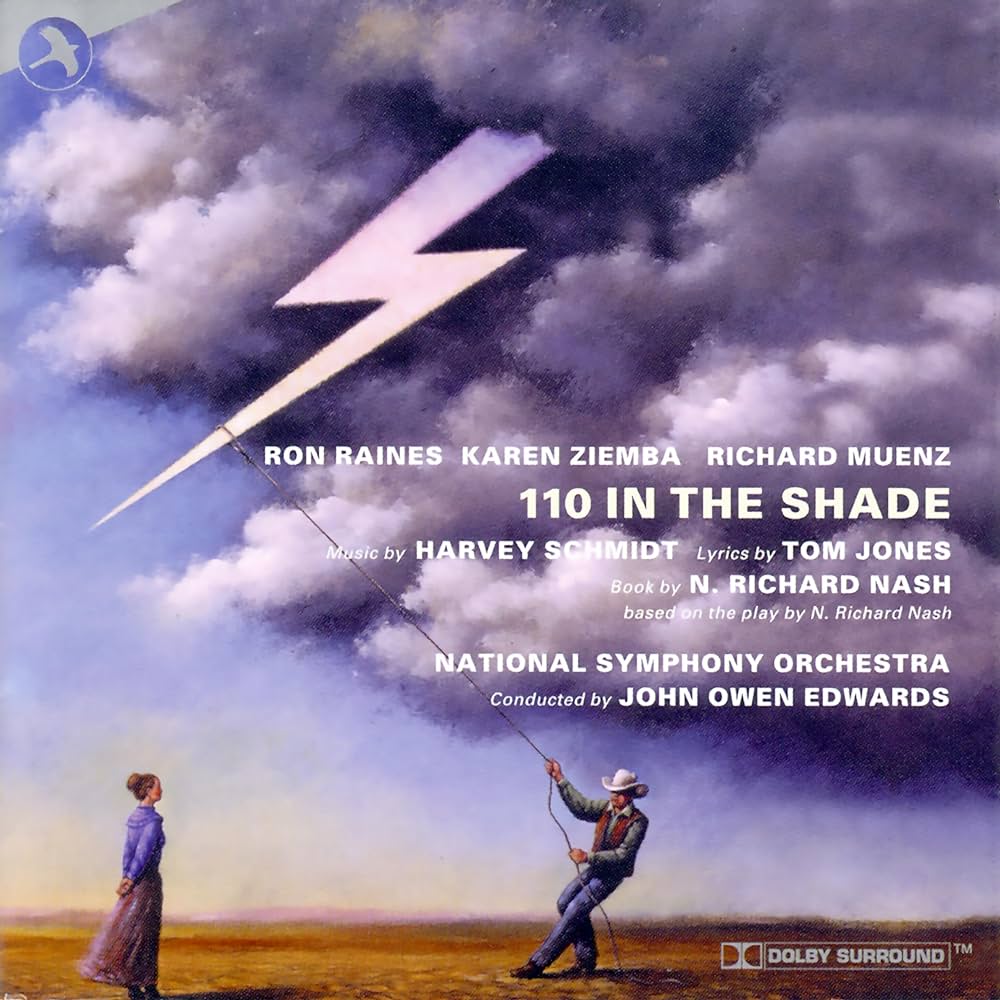
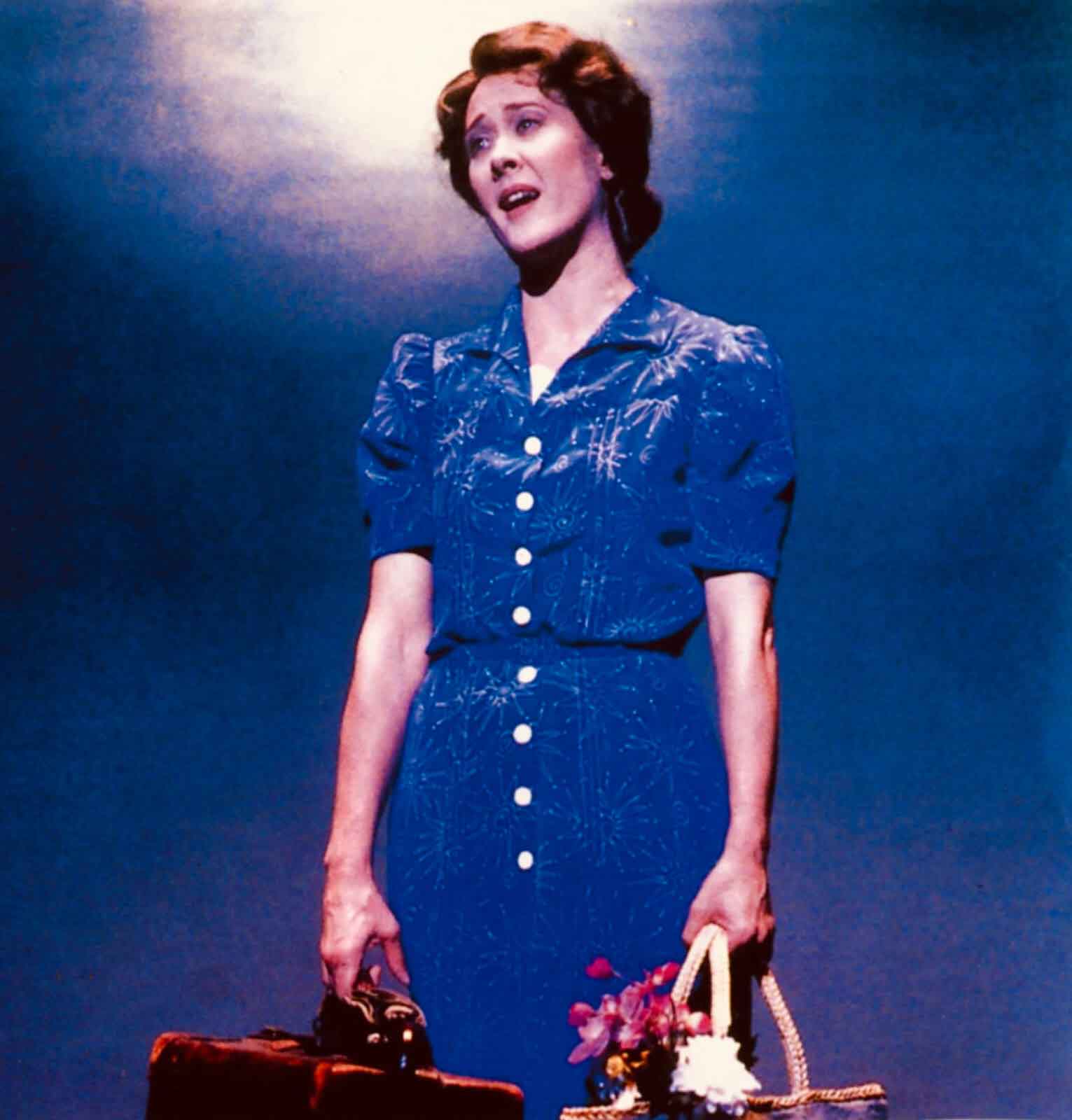
Fittingly, as the Broadway musical is closely linked to opera, the story was adapted into an opera for the New York City Opera in 1992. The production was directed by Scott Ellis, choreographed by Susan Stroman, and starred Karen Ziemba as Lizzie Curry.
There is a studio recording of the opera with five bonus tracks, but it wasn't realized until 1997.
Fun Fact: The opera orchestra was larger than the Broadway pit orchestra so the score was done better than the original Braodway production.
A couple of years later, a concert version was staged at the Fortune Theatre in London directed by Ian Marshall Fisher with Louise Gold as Lizzie Curry. This production was done for the Discovering Lost Musicals Charitable Trust.
Fun Fact: The production only used piano accompaniment.
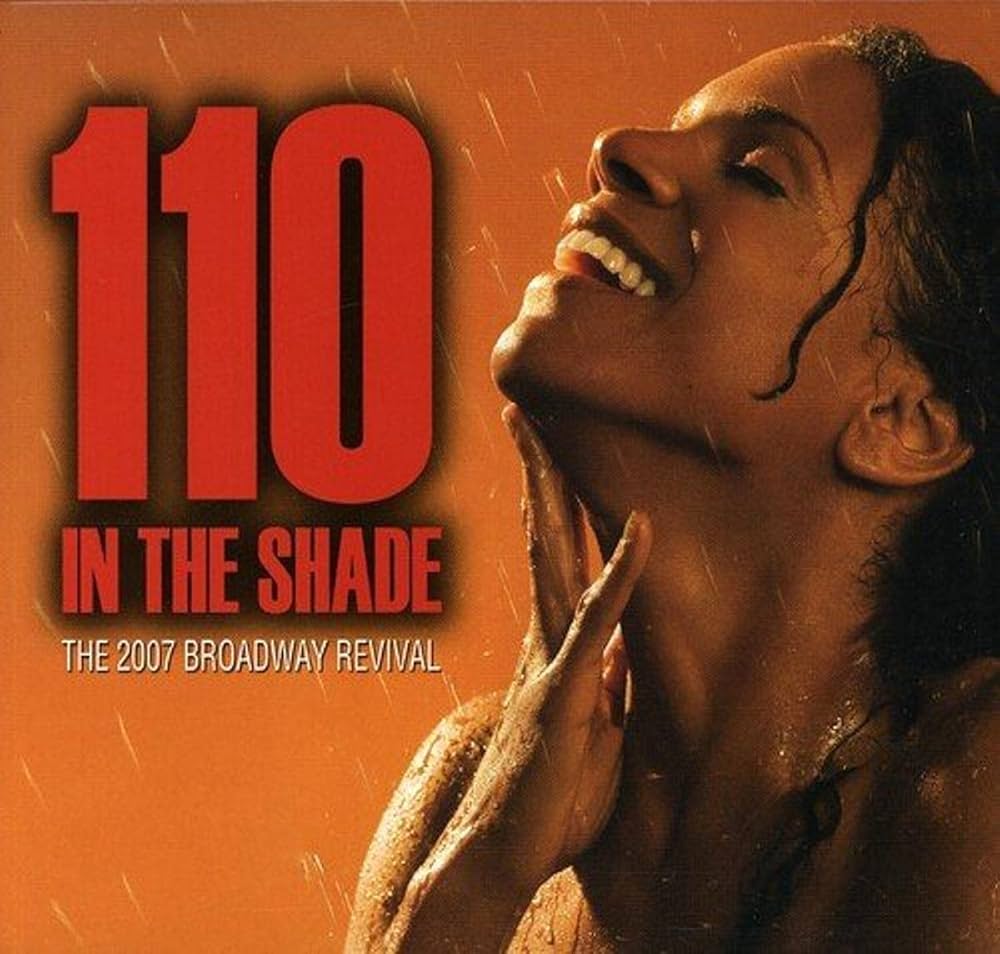
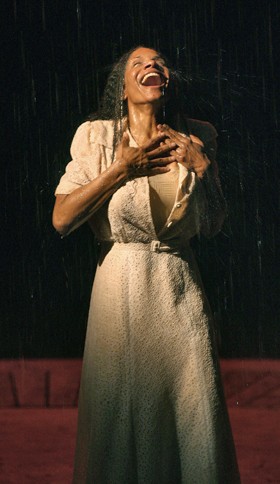
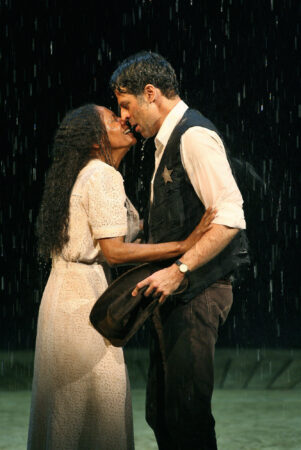
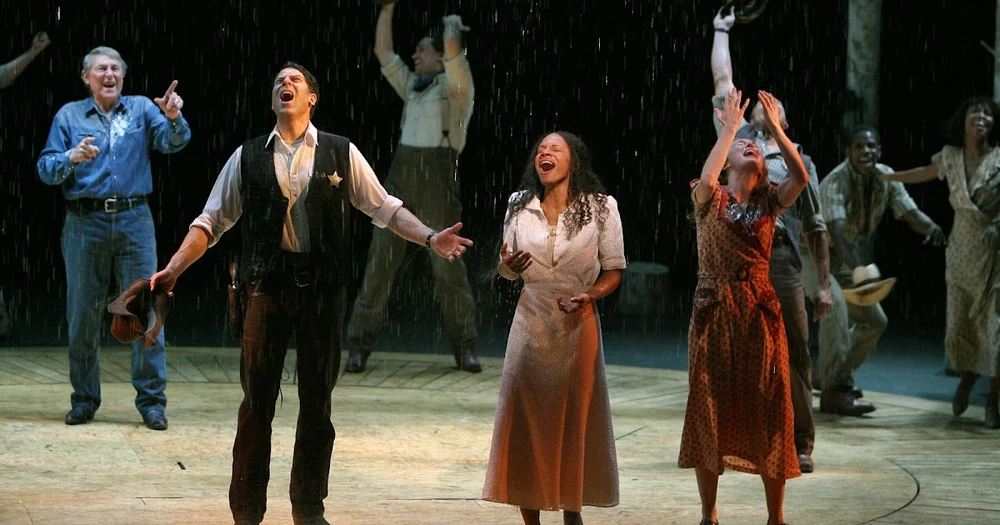
The show was revived in 2007 by the Roundabout Theater Company opening on May 9, 2007. In charge of this revival was director Lonny Price, designer Santo Loquasto, lighting designer Christopher Akerlind, sound designer Dan Moses Schreier, musical arranger David Krane, and musical supervisor Paul Gemignani. The cast featured star Audra McDonald along with Steve Kazee and John Cullum. The show ran for 27 previews and 94 performances before closing on that same year.
Unfortunately, the show was met with mixed feelings.
Fun Facts:
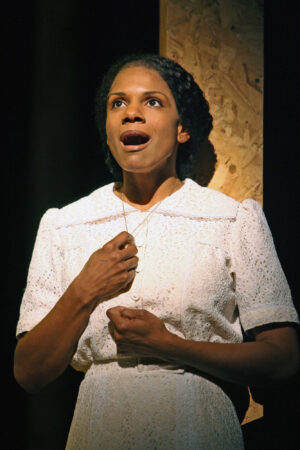
It's July 4, 1936 when an incredible heat wave has hit a small, western town in the U.S. The residents of the town including Sheriff File lament over this heat wishing for rain ("Another Hot Day"). Elsewhere in town, a rancher family comprising of H.C. Curry, Noah Curry, and Jimmy Curry are anticipating the arrival of their daughter/sister, Lizzie Curry ("Lizzie's Coming Home"). Her coming home is met with celebration, and the men are eager to hear how her trip was as she had been visiting friends of their family. It's quickly evident that the trip was designed to find Lizzie a husband, but unfortunately, the trip was a failure. Lizzie's personality full of intelligence and wit got her in trouble, and her insecurities about her looks caused her to hide in shame. Hearing this, H.C., Noah, and Jimmy decide not all is lost and plan to invite Sheriff File to the annual picnic lunch where Lizzie hopefully can catch his attention. Hesitant, but hopeful, she accepts the new plan ("Love Don't Turn Away").
The Curry boys invite File to the picnic to spend time with Lizzie ("Poker Polka"), but unfortunately, File's mind is set on a new report of an outlaw known as Tornado Johnson heading into their town. Noah and Jimmy leave, but H.C. stays behind to tell File off. He reveals he knows File's secret: File's wife left him. H.C. believes File will heal if he allows himself to get out there and have some fun, and Lizzie is the person he can have fun with, but File just grows more defensive so H.C. leaves him alone.
Later, everyone is at the picnic grounds with the ladies preparing their food ("The Hungry Men"). Lizzie who had also prepared a basket for File feels dejected when she can't find File amongst the crowd. The Curry boys try to console her but do a terrible job at it telling her to be more like the popular girl like Lily Ann Beasley and less like herself. Lizzie completely rejects the idea when suddenly the hear a crack of thunder.
Bill Starbuck appears aka Tornado Johnson. Or as Starbuck introduces himself "The Rainmaker". He promises that if they pay him he will bring rain withing twenty-four hours. This bold idea brings the town into a frenzy quickly believing that he can truly bring rain ("The Rain Song").
The only one who isn't convinced is Lizzie, and she is shocked that her father gives Starbuck a hundred dollars which is basically their life savings. Angry, she accuses him of deception, but not one to back out of a challenge, Starbuck accuses her of being no different ("You're Not Foolin' Me"). They both strike a nerve and leave bitter and frustrated with Lizzie remembering a childhood song she knew ("Cinderella"). Because of the conversation, Lizzie vents to H.C. and imagines herself as someone prettier and dumber who catches all the men's eyes ("Raunchy").
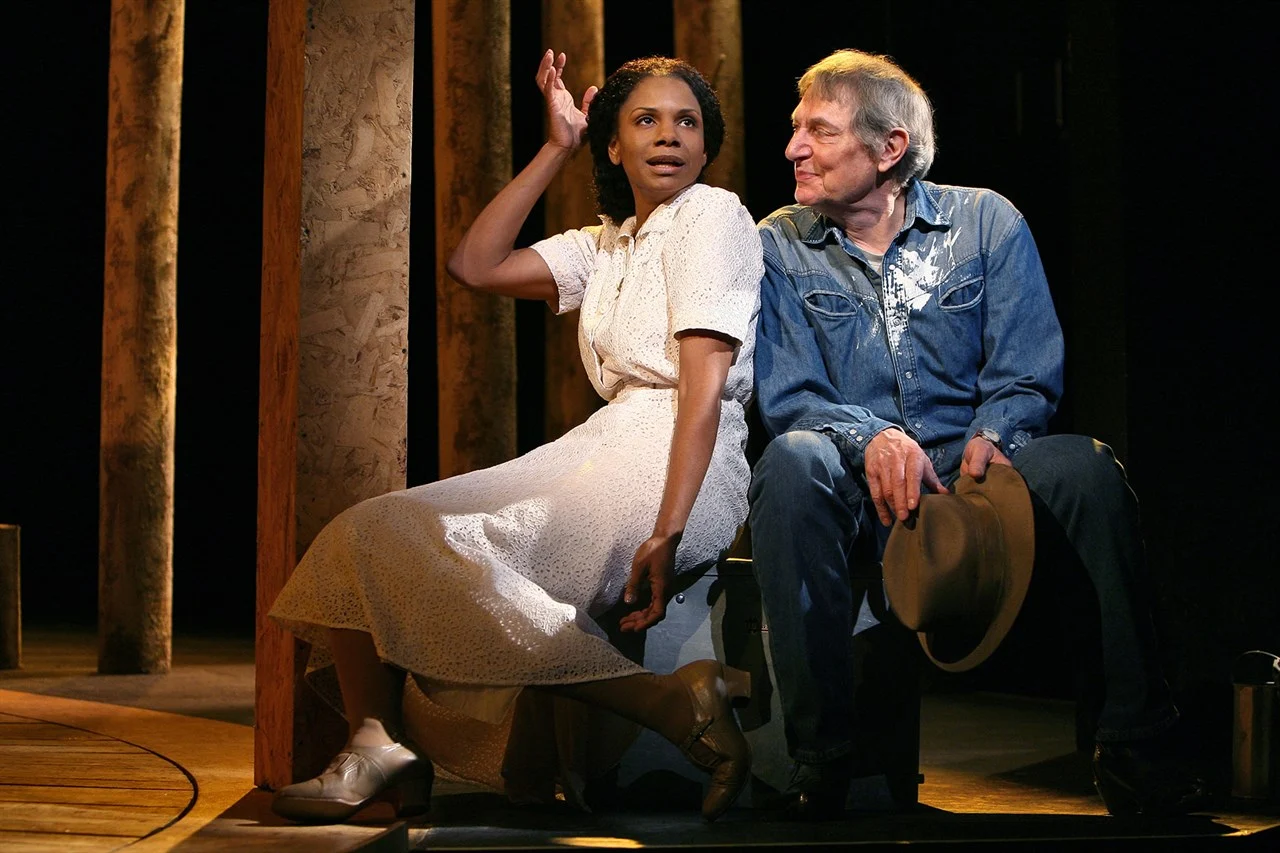
Unexpectedly, File appears wanting to talk to Lizzie so H.C. leaves giving them some privacy. Feeling awkward and vunerable, File comes clean about his past about how his previous wife left him for another man, and he lied to everyone saying he was a widower to hide the shame. Surprised by his honesty, Lizzie decides to open up about her insecurities and dreams, and the two become closer ("A Man and a Woman"). However, Lizzie starts to panic and tries to be more like a Lily Ann Beasley type of character, but this only confuses and angers File. He ends up storming away in a fury, and hearing the fight, the Curry boys rush over to Lily to figure out what happened. Despite H.C.'s attempts to console her, Noah lashes out hearing what Lizzie did and insist she just accept that she will always be alone. Shook to her very core, Lizzie crashes out and imagines the very future she fears ("Old Maid").
Watching the stars, Starbuck is alone and enjoying the quiet ("Evenin' Star").
On the picnic grounds, couples are enjoying the night and each other ("Everything Beautiful Happens at Night"). Everyone is at peace and happy.
Except for Lizzie who for some reason finds herself drawn to Starbuck. The two connect, and seeing Lizzie's unhappiness, Starbuck encourages her to dream again, but this time out there far beyond her little town ("Melisande"). While she enjoys the stories Starbuck spins, Lizzie counters those dreams with her own that are much more simple, plain, and real than the dramatic fantasy world Starbuck created for her ("Simple Little Things"). Despite her dreams, she breaks down believing she'll never get what she wants, but Starbuck stops her. He continues to encourage her to see herself through her own eyes to recognize her own beauty, and not fear how others view her. Overcome with gratitude, the two kiss and spend the night together.
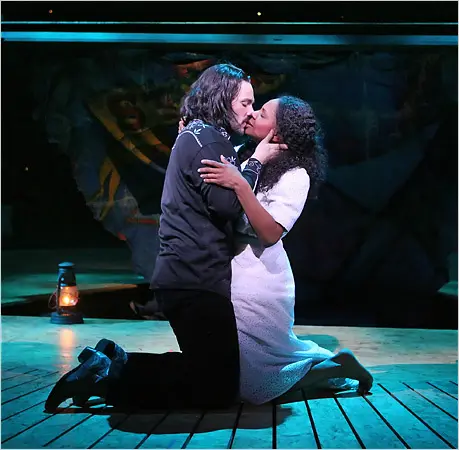
Later away from Starbuck's camp, H.C. and Noah learn from Jimmy that he and his new girl Snookie Updegraff are together now ("Little Red Hat"). After they tell their story, File arrives to tell the Curry family he's on the lookout for Starbuck. H.C., knowing Lizzie is with Starbuck, doesn't reveal Starbuck's location. Noah is shocked by this and even more shocked that their father is willing to leave Lizzie alone with a conman, but H.C. defends her.
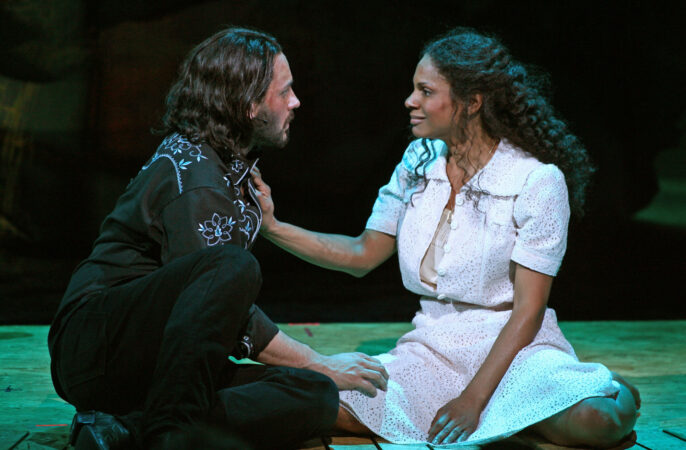
Meanwhile, back at Starbuck's camp, he shares a secret: he's never made rain in his life. However, Lizzie isn't surprised by this and wanted to be with him for him not for his self-imagined powers. Starbuck has shown her what true beauty is, and for that, she loves him ("Is It Really Me?")

Later, the Curry family are waiting around for Lizzie to come back. Despite the tension, Lizzie and Starbuck ignore this and come back filled with glee. Lizzie announces she and Starbuck are together, but then, File arrives to arrest the conman. However, because of Lizzie's newfound happiness, the Curry boys defend Starbuck. Understanding he needs to go, Starbuck implores Lizzie to join him in his travels, and File realizing what he is about to lose pleads Lizzie to stay ("Wonderful Music"). With a new sense of her own worth, Lizzie makes her decision to stay home as that is her dream.
Starbuck respects this, and as he leaves, a low rumble of thunder is heard. It starts to rain. For the first time ever, Starbuck made rain appear in twenty-four hours. The townspeople come out and revel in the downpour celebrating the change of weather while Lizzie and File rejoice in the promise for love, hope, and renewal ("The Rain Song (Reprise)").
Key Traits:
is a sharp, intelligent, and emotionally guarded young woman living on her family’s drought-stricken farm, where she is labeled “plain” and feels deeply undervalued by her community and her domineering father. Using blunt honesty and sarcasm as armor, she hides a profound loneliness and longing to be loved for who she truly is rather than out of pity or desperation. Lizzie resists the narrow expectations placed on women, yet she aches for purpose, dignity, and connection. Her encounter with the rainmaker Starbuck awakens her hope and forces her to confront whether change comes from illusion or inner strength. By the end of the musical, Lizzie does not transform into someone else but instead claims her own worth, choosing self-respect and independence over false promises or societal pressure.
Lead
Female
20s-30s
Mezzo-Soprano
Vocal Range: G3 to G#5
Special Technique: Opera, Belting
is a charming, quick-witted con man who arrives in the drought-ridden town claiming he can bring rain—for a fee. Confident, intelligent, and instinctively persuasive, he believes survival comes from cleverness rather than honesty. Bill moves through life unrooted, relying on illusion and charm to get by, but his growing connection with Lizzie Curry challenges his cynicism and reveals a quieter vulnerability beneath his bravado. Torn between genuine love and his instinct to run before the truth catches up with him, Bill embodies the tension between hope and deception, belief and reality.
Lead
Male
30s-40s
Baritone
Vocal Range: G2 to G#4
is the authoritative, no-nonsense lawman of the small, drought-stricken town. Practical and conservative, he represents order, tradition, and the status quo, enforcing the town’s rules with a firm hand and little patience for disruption. Deeply skeptical of outsiders—especially the charismatic rainmaker Bill Starbuck—File sees it as his duty to protect the town from false hope and chaos. Though stern and often rigid, his actions stem from a genuine belief in responsibility and social stability rather than cruelty. Sheriff File functions as a moral and political counterweight in the story, embodying the tension between caution and faith, realism and belief, law and longing.
Supporting
Male
30s-40s
Baritone
Vocal Range: A#2 to F#4
is Lizzie Curry’s younger brother and a well-meaning but impulsive young man whose heart often runs ahead of his judgment. Loyal, affectionate, and deeply protective of his sister, Jimmy believes he knows what’s best for her—even when his actions complicate her life. He is earnest and passionate, especially when it comes to justice and fairness, but his quick temper and emotional immaturity sometimes land him in trouble. Jimmy represents youthful idealism and small-town frustration: he longs for purpose, recognition, and a sense of manhood in a rigid community that offers him few outlets.
Supporting
Male
18-20s
Tenor
Vocal Range: A#2 to E5
Supporting
Male
50s-60s
Baritone
Vocal Range: A#2 to E4
Supporting
Male
20s-30s
Baritone
Vocal Range: A#2 to Eb4
Supporting
Female
18-20
Mezzo-Soprano
Vocal Range: C3 to E5
Toby
Olive Barrow
Geshy Toops
Mrs. Jensen
Gil Demby
Belinda
Bo Dollivan
Wally Skacks
Phil Mackey
Mr. Curtis
Maurine Toops
Tommy
After their success with the Off Broadway show "The Fantasticks", Harvey Schmidt and Tom Jones started working on "110 in the Shade". It was their first project for Broadway. They were determined to be faithful to the original play by making very few changes to the overrall story and dialogue. Many of the lyrics actually came directly from the play.
The few changes that were made were mostly set related. The original play was set indoors so they moved most of the interior scenes outdoors to allow for ensemble dance numbers.
Their original score for the musical was operatic, but they found the original runtime was too long so they began cutting numbers. Schmidt and Jones ended up cutting half of their musical numbers, and the music that still exists is in the final product we can see today.
Keep in mind that "110 in the Shade" comes from the Golden Age of Broadway musicals (1940s-1960s). These shows were known for their big, upbeat, show-stopping musical numbers, great, emotional singing, and intense drama with a story that seeks to be more than meets the eye. "110 in the Shade" was created to be no different.
While Jones took inspiration from Nash's original dialogue, Schmidt drew inspiration from various American musical sounds and expressions particularly from the west and south to create the score. Furthermore, the two wanted the music to be character-driven. Bill Starbuck, being the charismatic con man he is, is often singing along to more popular styles like jazz, blues, and Latin to make his stories more alluring and believable like in "The Rain Song" and "Melisande". Meanwhile, Lizzie Curry's musical numbers fuel her longing for a simple life with someone to love. She gets these beautiful, simple ballads with lilting lyrics that only become bigger and more dramatic whenever Starbuck sings with her. On the other hand, comic relief characters like the Curry family and Snookie will get songs that are more upbeat and cheerful.
Bill Starbuck uses a variety of subtle and overt manipulation tactics to achieve his goals, particularly in persuading the Curry family to believe in his rainmaking abilities and in shifting Lizzie’s self-image.
The town's desperate need for rain mirrors Lizzie's longing for love, with the arrival of Starbuck symbolizing the possibility of hope in bleak circumstances.
Lizzie learns to value herself beyond societal pressures, realizing she doesn't need to change to be loved.
The musical contrasts different types of love: the cautious, fearful love of Sheriff File versus the passionate, transformative love offered by Starbuck, culminating in choices about genuine connection.
Starbuck’s rainmaking blurs the line between faith and fraud. The show never offers an easy answer as to whether belief itself has power even if the source of that belief is questionable.
Nearly every character is “performing” a version of themselves: Starbuck performs confidence and authority, Lizzie performs bitterness to protect herself, and the townspeople perform skepticism while secretly hoping. The musical asks whether truth matters more than the effect of belief.
Despite being part of a community, many characters are deeply alone: Lizzie feels emotionally isolated and unloved, and Sheriff File is trapped between duty and doubt. Even Starbuck is fundamentally alone, always moving on.
Lizzie embodies the pressure placed on women, particularly older, unmarried women, to be agreeable, desirable, and grateful. But, the story also showcases women like Lizzie wanting to be seen and appreciated for who she is, not just as a potential wife. This theme quietly critiques how women are dismissed once they no longer fit romantic ideals.
Lizzie's story is reclaiming her own power learning that hope doesn’t have to come from someone else.
Starbuck is a charismatic "con man" who offers fantasy, but ultimately finds his own truth and desire for a real life with Lizzie, blurring the lines between illusion and reality.
While both the 1963 musical and the 2007 revival tell the same story and use the same materials, there are some slight differences between the two.
1963 Original Broadway Musical
The score was originally more expansive and operatic in scope.
Trimming occurred during early tryouts to tighten pacing.
Musical numbers were integrated into a sweeping depiction of the town’s communal life and emotional landscape, with choreography and ensemble pieces underlining the oppressive heat and emotional drought.
2007 Broadway Revival
The revival generally retained the original book and score, but updated elements.
Added a new song, "Evenin Star" to give more depth to Starbuck's character.
Emphasis was placed on intimate storytelling with stripped-down, character-focused staging, in contrast to the more expansive original Broadway production.
I hope you learned something new! Check out some of my other blogs and learn more about the world of musical theatre 🙂 See you later!
Unfortunately, there is no way to watch or stream the 2007 production. There are, however, some clips of the performance on YouTube you can watch for free.
Yes, there is a cast album. You can find it on digital platforms like Spotify, YouTube, or Apple Music. Or, you can buy a physical copy on places like Amazon, eBay, or The Broadway Store.
Audra McDonald starred as Lizzie Curry in the revival of "110 in the Shade".
Audra McDonald starred as Lizzie Curry in the revival of "110 in the Shade".
All the reviews praised Audra McDonald for her performance and singing but found the rest of the show lackluster. So, the response was mixed.
Currently, there is no available free script of "110 in the Shade". However, here is the full score of the musical.